
Indications
Intravenous Adecard is indicated for the following: Conversion to sinus rhythm of paroxysmal supraventricular tachycardia (PSVT), including that associated with accessory bypass tracts (Wolff-Parkinson-White Syndrome).
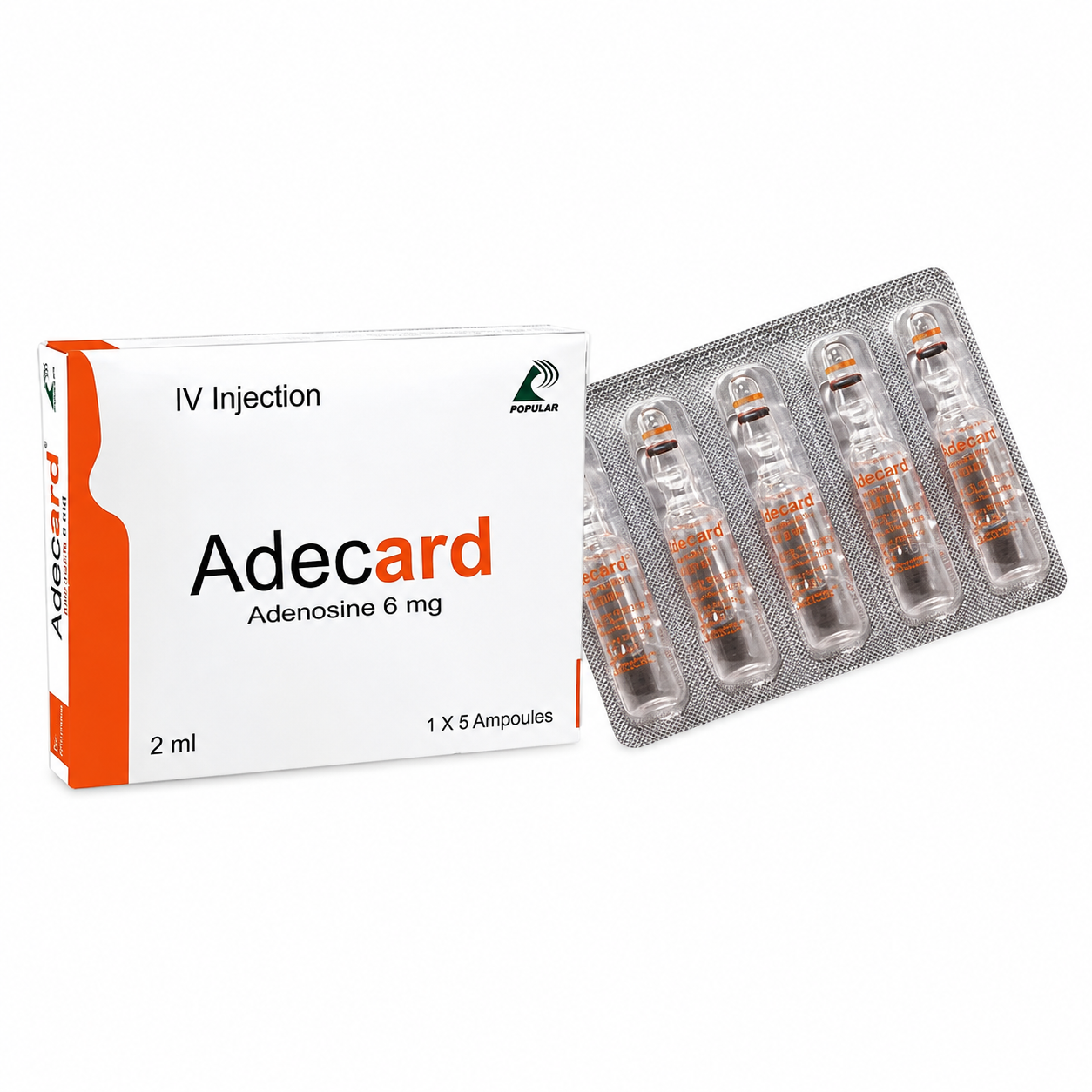
Adecard IV Injection
Adenosine
6 mg/2 ml
Popular Pharmaceuticals Ltd.
5 Ampoules 1box
For Any Queries Call Us On
+8809638058333
750.00৳
Intravenous Adecard is indicated for the following: Conversion to sinus rhythm of paroxysmal supraventricular tachycardia (PSVT), including that associated with accessory bypass tracts (Wolff-Parkinson-White Syndrome).
This preparation is a sterile, nonpyrogenic solution for rapid bolus intravenous injection. Adenosine injection slows conduction time through the A-V node, can interrupt the reentry pathways through the A-V node, and can restore normal sinus rhythm in patients with paroxysmal supraventricular tachycardia.
Adult:
Pediatric: The dosages used in neonates, infants, children and adolescents were equivalent to those administered to adults on a weight basis.
Repeat administration: If conversion of PSVT does not occur within 1-2 minutes, additional bolus injections of adenosine can be administered at incrementally higher doses, increasing the amount given by 0.05 to 0.1 mg/kg. A saline flush should follow. This process should continue until sinus rhythm is established or a maximum single dose of 0.3 mg/kg is used.
Intravenous Adecard injection has been effectively administered in the presence of other cardioactive drugs, such as Quinidine, beta- adrenergic blocking agents, Calcium channel blocking agents and angiotensin converting enzyme inhibitors without any change in the adverse reaction profile. Digoxin and Verapamil use may be rarely associated with ventricular fibrillation when combined with Adecard. Because of the potential for additive or synergistic depressant effects on the SA and AV nodes, however, Adecard should be used with caution in the presence of these agents. The use of Adecard in patients receiving Digitalis may be rarely associated with ventricular fibrillation. The effects of Adecard are antagonized by Methylxanthines, such as, Caffeine and Theophylline.
Intravenous Adenosine is contraindicated in:
Cardiovascular: Facial flushing, headache, sweating, palpitations, chest pain, hypotension. Respiratory: Shortness of breath/dyspnea, chest pressure, hyperventilation, head pressure.
Central Nervous System: Lightheadedness, dizziness, tingling in arms, numbness, apprehension, blurred vision, burning sensation, heaviness in arms, neck and back pain.
Gastrointestinal: Nausea, metallic taste, tightness in throat, pressure in groin. In post-market clinical experience with Adecard, cases of prolonged asystole, ventricular tachycardia, ventricular fibrillation, transient increase in blood pressure, bradycardia, hypotension, atrial fibrillation and bronchospasm, in association with Adecard use, have been reported.
US FDA pregnancy category C. Animal reproduction studies have shown an adverse effect on the fetus and there are no adequate and well-controlled studies in humans, but potential benefits may warrant use of the drug in pregnant women despite potential risks.
The half-life of Adecard is less than 10 seconds. Thus, adverse effects are generally rapidly self-limiting. Treatment of any prolonged adverse effects should be individualized and be directed toward the specific effect. Methylxanthines, such as, Caffeine and Theophylline, are competitive antagonists of Adecard.
Paroxysmal supraventricular tachycardia (PSVT)
Store in cool dry place protected from light. Keep out of reach of children. Do not refrigerate as crystallization may occur. If crystallization has occurred, dissolve crystals by warming to room temperature. The solution must be clear at the time of use.
Only logged in customers who have purchased this product may leave a review.

There are no reviews yet.