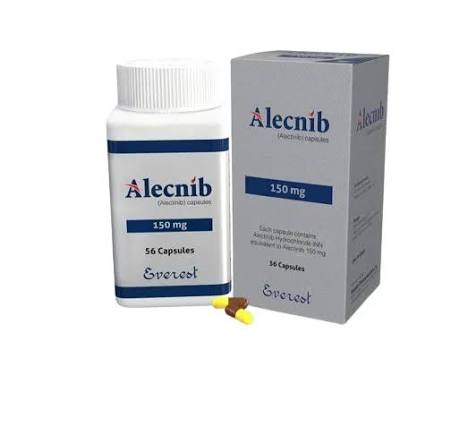
Based on in vitro data, CYP3A4 is the primary enzyme mediating the metabolism of both Alecnib and its major active metabolite M4, and CYP3A contributes to 40% – 50% of total hepatic metabolism. M4 has shown similar in vitro potency and activity against ALK.
CYP3A inducers: Co-administration of multiple oral doses of 600 mg rifampicin once daily, a strong CYP3A inducer, with a single oral dose of 600 mg Alecnib reduced Alecnib Cmax, and AUCinf by 51% and 73% respectively and increased M4 Cmax and AUCinf 2.20 and 1.79-fold respectively. The effect on the combined exposure of Alecnib and M4 was minor, reducing Cmax and AUCinf by 4% and 18%, respectively. Based on the effects on the combined exposure of Alecnib and M4, no dose adjustments are required when Alecnib is co-administered with CYP3A inducers. Appropriate monitoring is recommended for patients taking concomitant strong CYP3A inducers (including, but not limited to, carbamazepine, phenobarbital, phenytoin, rifabutin, rifampicin and St. John’s Wort (Hypericum perforatum).
CYP3A inhibitors: Co-administration of multiple oral doses of 400 mg posaconazole twice daily, a strong CYP3A inhibitor, with a single oral dose of 300 mg Alecnib increased Alecnib exposure Cmax and AUCinf by 1.18 and 1.75-fold respectively, and reduced M4 Cmax and AUCinf by 71% and 25% respectively. The effect on the combined exposure of Alecnib and M4 was minor, reducing Cmax by 7% and increasing AUCinf 1.36-fold. Based on the effects on the combined exposure of Alecnib and M4, no dose adjustments are required when Alecnib is co-administered with CYP3A inhibitors. Appropriate monitoring is recommended for patients taking concomitant strong CYP3A inhibitors (including, but not limited to, ritonavir, saquinavir, telithromycin, ketoconazole, itraconazole, voriconazole, posaconazole nefazodone, grapefruit or Seville oranges).
Medicinal products that increase gastric pH: Multiple doses of esomeprazole, a proton pump inhibitor, 40 mg once daily, demonstrated no clinically relevant effect on the combined exposure of Alecnib and M4. Therefore, no dose adjustments are required when Alecnib is co-administered with proton pump inhibitors or other medicinal products which raise gastric pH (e.g. H2 receptor antagonists or antacids).
Effect of transporters on Alecnib disposition: M4 is a substrate of P-gp. As Alecnib inhibits P-gp, it is not expected that co-medication with P-gp inhibitors has a relevant effect on M4 exposure.



There are no reviews yet.